
Why a 'Spiritual Living Room' Beats a Meditation App

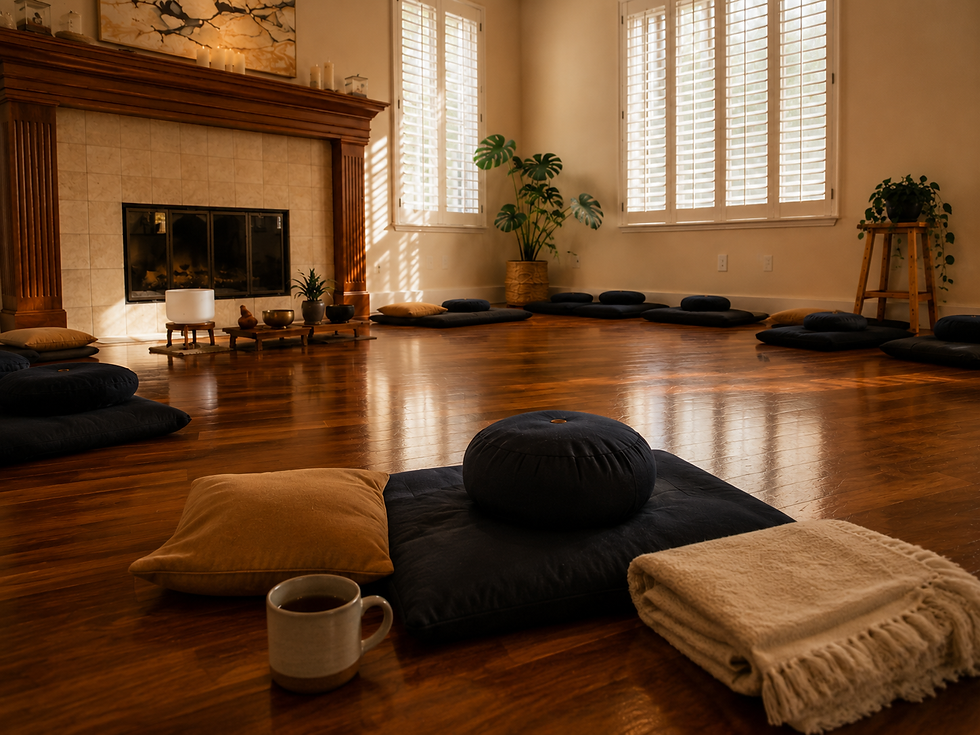
The image of the "spiritual living room" arrived for us early in DAI's planning, and it has held up better than most early phrases tend to. We use it on the homepage, in conversations with potential members, and quietly to ourselves when we are making decisions about what kind of community we are trying to build. The phrase has come to mean something quite specific. I want to write about what it means, what it does not mean, and why we think it offers something that meditation apps, despite their genuine usefulness, structurally cannot.
The apps did some things well
It is worth saying clearly, before any critique, that the meditation apps have done a real service in the last decade. They have brought contemplative practice into the daily life of millions of people who would never otherwise have set foot in a Buddhist temple or a yoga studio. They have removed the cultural threshold that, for a long generation, kept secular practitioners away. They have made the basic instructions of meditation widely accessible in the practitioner's own language and on their own time. None of this is small.
The apps have also done a notable thing in the realm of normalization. A practice that, a few decades ago, would have been seen as fringe is now part of the mainstream conversation in workplaces, in clinical care, and in conversations between friends. The cultural soil for deeper contemplative work has been quietly tilled by the success of the apps.
A community like DAI does not exist to compete with the apps. It exists, more accurately, to be the next thing for the practitioner who has been formed by the apps and has begun to outgrow them.
What the apps cannot do
There is a structural feature of an app — any app — that limits how far the practice can go inside its frame. The app is *between the practitioner and the room*. It is mediated. It is solitary. It is replaceable, in the sense that the practitioner can close it and never open it again, and nothing in the world will register the absence.
The contemplative traditions, across many centuries and many cultures, have noticed that practice held only inside the individual practitioner tends, over time, to fade. The reasons are not mysterious. Solitary practice depends on the practitioner's own consistency. It receives no correction from a teacher who knows the long path. It is not bound up with anyone else's life. It is, in a quiet way, easy to put down.
The traditions have, again across many cultures, come up with the same response to this problem. They have built *sangha* — community — into the structure of the practice. The Buddha named community as one of the three pillars of the path. The yogic traditions developed *satsang*, the keeping of company with those who are also walking the path. The Christian monastic traditions built communities whose entire purpose was to hold practice across the lifetime of its members. The Sufi tradition developed the *dhikr* circle. The Quakers developed the silent meeting. In every case the teaching is the same: practice grows in the company of others practicing.
The apps cannot, by their nature, provide this. A user community on an app, however large, is not the same kind of thing as a room of people who, this Sunday morning, will see each other in the same room and recognize that someone is missing and ask, gently, whether they are alright.

What the living-room image points to
The phrase *spiritual living room* came to Rebecca during an early conversation about what kind of space DAI should be. It was offered partly in contrast to the language usually used about meditation centers — *zendo*, *sanctuary*, *temple*, *studio*. Those words name a particular kind of room with a particular kind of formality. They are good words, and they describe their referents accurately. But they did not quite capture what we were trying to build.
What we wanted was a room where one could be a serious practitioner and also be ordinary. A room with cushions but also chairs. A room with tea. A room where one could arrive in work clothes, sit for half an hour, stay for the optional tea chat, ask a question one had been carrying for months, and leave changed in the way one is changed by a good conversation in a friend's kitchen — not the way one is changed by a transformative weekend at a retreat.
The living-room image holds this. A living room is a particular kind of space, in any home. It is more formal than the kitchen but less formal than the dining room set for company. It is where the people of the house, and their visiting friends, actually spend their time together. It is shaped by use. It accumulates books and cushions and small objects of meaning. It is, in the architecture of a good home, the room where the life of the household actually unfolds.
A *spiritual* living room is the same thing, but oriented toward inner life. A room where one's contemplative work is woven into the ordinary fabric of one's relationships. A room one can return to.

How this changes the practice
The practitioner who builds their relationship with meditation through a living-room community, rather than through an app, tends to experience the practice differently in three ways.
The first is *continuity across the difficult patches*. Every serious practitioner encounters periods in which the practice feels dry, or worse, hostile. In the app, these periods produce uninstalls. In a community, the practitioner has reasons to keep showing up that exist outside the immediate quality of the meditation itself — friends who will be in the room, a teacher whom the practitioner does not want to disappoint, a community that has welcomed them and to which they have begun to belong. The friction of leaving is, gently, real. The continuity that this produces, over the years, is the difference between meditation as a hobby and meditation as a way of life.
The second is *correction*. A practitioner sitting alone with an app will, with great reliability, develop small distortions in the practice that no amount of audio guidance will catch. The practitioner may be subtly straining. They may be holding the breath without knowing it. They may be unconsciously cultivating a particular kind of meditative experience and avoiding others. A teacher in a real room catches these things — usually not by direct correction but by the practitioner finding themselves in the teacher's presence and noticing what the teacher's relaxation reveals about the practitioner's tension.
The third is *the deepening that happens in the slipstream of other people's practice*. A practitioner sitting alone is limited, in any session, to what their own mind and body can accomplish. A practitioner sitting in a room of twenty other practitioners is, in some way that the traditions describe as real and that contemporary research is beginning to confirm, carried by the collective gravity of the room. The session goes deeper than the individual practitioner could have taken it. This is, by some accounts, what *sangha* is most precisely *for*.
What the apps remain useful for
None of this is to argue that the apps should be deleted. They remain useful for the moments between the room. A practitioner who attends weekly community meditation can usefully open an app on a Tuesday afternoon when a difficult meeting has just ended. They can usefully practice the breath at the airport. They can usefully fall asleep to a sleep meditation on a night when sleep has not been coming.
The apps work best, in our experience, when they are *supplementary* to a real community practice — not when they are asked to carry the entire weight of the practitioner's contemplative life by themselves.

A welcome
The DAI spiritual living room is located at 233 Homer Avenue in downtown Palo Alto. It is open during the weekly programs and at special events; it is, more accurately, *always* open, in the sense that the room is the same room whether ten people or fifty are in it on any given evening. The practice is by donation. No prior experience is required. No conversion is asked of you.
If you have been practicing on an app for a while and have been wondering whether something more lasting might be available somewhere, you are welcome to come and find out. Sunday Community Meditation is the easiest door. Bring nothing. Wear what you have. The room knows how to receive you.
We will save you a cushion.
---
*By the DAI community. Dharma Alive Incubator · 233 Homer Avenue · Palo Alto, CA · A spiritual living room.*


Comments