
What 'No One Turned Away for Cost' Really Means at DAI
Almost every nonprofit, somewhere on its website, includes a line about accessibility. Sometimes it is a sliding scale. Sometimes it is the phrase no one turned away for lack of funds. Sometimes it is the more elegant compression that has come to us through the public-broadcasting and contemplative-community traditions: no one turned away for cost. The phrase is becoming, by frequency of use, almost decorative. I want to write here about what we mean by it at Dharma Alive Incubator, and what we have built into the operations of the organization to keep the phrase honest.
Why the phrase exists at all
There is a long contemplative argument, older than this country and older than most of the wisdom traditions DAI hosts, that practice should not be a commodity. The argument has many forms. In the Chan and Zen lineages it appears as the principle that the dharma was given freely and ought to flow freely. In the yogic traditions it appears in the relationship between teacher and student as guru-dakshina, an offering made according to capacity rather than market rate. In the Christian contemplative orders it appears as the practice of hospitality — that those who arrive at the monastery's gate should be received as Christ would be received, regardless of their means. In each case, the teaching is the same: a transmission of practice that is gated by money ceases, somewhere along the way, to be a transmission of practice.
This is not a claim against material support. Communities need rent paid, electricity on, teachers compensated, books printed. It is a claim about what should determine access. The argument is that the gate, if there must be one, should be sincerity of interest, not net worth.
The phrase no one turned away for cost is the operational form of that argument.
What it does not mean
The phrase is sometimes misread, on the side of generosity, as a claim that the practice should be free. It is not that. DAI charges for several things — for the YTT-200 teacher training, for special events, for the on-demand video library — and most of the teachers in the community earn at least part of their livelihood from teaching here. Free practice is not the goal. Available practice is.
The phrase is also sometimes misread, on the side of suspicion, as a vague aspiration without operational meaning. We have tried to make sure that is not what it is here. The phrase, if it is to be honest, must correspond to actual policies a person can rely on.
What we have actually built
Three concrete things make the phrase operational at DAI.
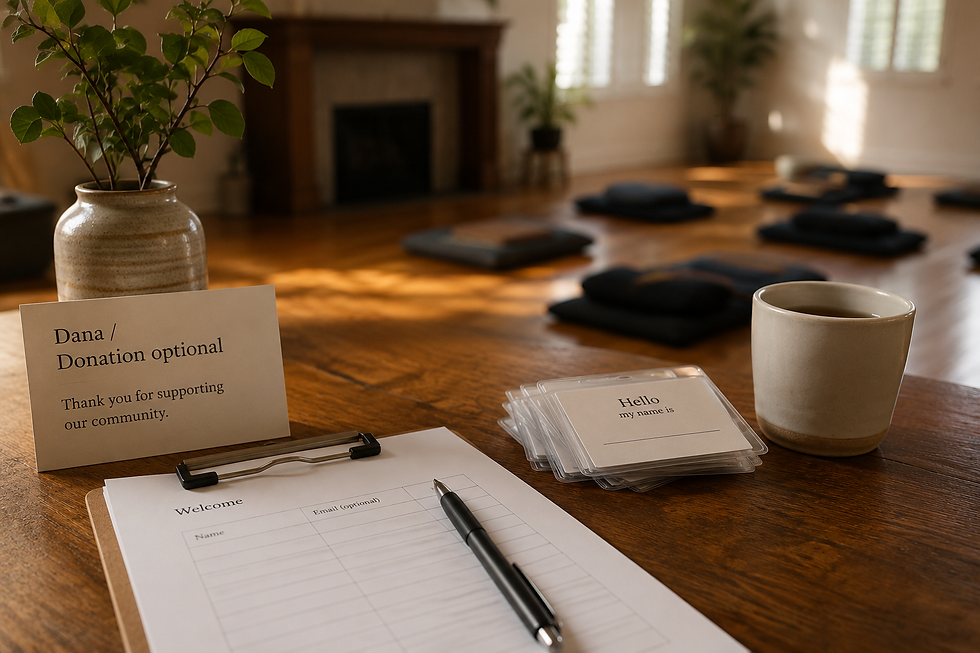
The first is that the weekly community programs are by donation. Sunday Community Meditation, Spiritual Book Clubs, Hiking Meditation, and Potlucks — the regular cadence of the community is supported by those who can give what they can. The room is open to anyone who arrives, with no question asked at the door about means. Some attenders give twenty dollars. Some give nothing. Some, having attended for many months without giving, eventually give a great deal at once. We have found, across many traditions and over many centuries, that this evens out — and that it almost always does so in ways that surprise the organization in the right direction.
The second is a scholarship policy for the things that do cost money. The 200-hour Yoga Teacher Training, the on-demand library, and the special-event series can be expensive. For these, we maintain a scholarship application — one short form, one quiet conversation, and a decision made within a small window. The scholarship may cover the full tuition or part of it. Work-study options exist for those who would prefer to contribute time rather than receive aid. We do not require documentation of financial hardship beyond the applicant's own statement, because the practice of asking the seeker to prove their poverty has done, in our view, more damage to communities than it has prevented misuse.
The third, and perhaps the least visible, is that the entire operational structure of the organization is designed to make the first two sustainable. DAI is a 501(c)(3) nonprofit. The teachers are compensated through a transparent revenue-sharing model that does not depend on any individual class being maximally full. The board is structured so that no single individual benefits financially from raising prices. The whole thing is built, deliberately, so that the phrase no one turned away for cost does not have to be defended every fiscal quarter.
A few honest limits
To say the phrase honestly is also to acknowledge what it does not promise. We cannot, for instance, provide everyone with a free private lesson with a senior teacher — those are limited by the teacher's time, not by money. We cannot promise that scholarships will be available at every level for every program in every year; some teacher trainings have a small fixed number of scholarship seats. We cannot waive the costs that go to outside vendors — the cost of a Yoga Alliance certification fee, for example, or of a guest teacher's travel.
What we can promise is that the weekly heart of the community — the practice itself — will remain available to whoever shows up, in whatever financial condition they show up in, for as long as DAI exists.

A small note to those who would attend if they could afford it
If you have been wanting to come and have been quietly assuming you cannot — please come. Bring nothing. Wear what you have. Walk in. The door is open in the most literal sense.
If you have been wanting to take a longer training or buy an on-demand series and the price has been the obstacle, please write. We have a scholarship form. We do not need the story of your financial life; we need only your name, the program you want, and a brief sense of what would make it possible. The conversation is brief and the answer comes quickly.
A small note to those who can afford to give
Communities that practice no one turned away for cost depend, structurally, on the generosity of those who can afford to give a little more than the cost of what they receive. If you have been attending and have been wondering whether to deepen your giving — whether to make a recurring donation, whether to fund a scholarship seat for someone else or to contribute to the thriving of our community — the answer, gently, is yes. Your generosity is what keeps the gate open for the next person who arrives.
And the next person who arrives may, in time, become the person who keeps the gate open for the one after that.
The deeper meaning
There is a phrase in the Zen tradition: the gate of sweet dew. It refers to the moment in which the teaching is finally received — when the gate to the deepest accessibility opens for a practitioner who has been waiting at it without quite knowing how. The phrase suggests, among other things, that the gate is always open; only the perception of the gate as closed needed to be released.
No one turned away for cost is, in its own way, a translation of that older phrase into the language of a 501(c)(3) operating budget. It is what we mean when we say the gate is open. And it is what we have built, in the form of policies and structures, to keep it that way.
We hope you come.
中文版
"不因费用拒人于门外"(No One Turned Away for Cost)这句话,在湾区的非营利机构里几乎成了一种装饰。但对许多刚到湾区、或者正在职业过渡期、或者刚成为父母、或者把所有积蓄投在一份理想上的华人朋友来说,"我能不能负担得起"这件事是真实的、每天都在算的。我们想在这里把这句话讲清楚——在 Dharma Alive Incubator,它具体意味着什么。
我们的做法很朴素:核心的共修活动免费且公开(周日早上 10:00 的社区共修),课程和工作坊设有滑动收费阶梯,对真正负担不起的朋友提供助学金和以工换学(work-study)。申请助学金不需要详细的财务证明,只需要一封简短的诚意说明,由老师团队保密审阅。我们也欢迎以中文提交申请——这不是一个加分项,而是一个本来就应该有的选项。
我们做这些事,不是因为我们在做慈善,而是因为我们相信:一个真正的修行社群,不应该把"是否有钱"放在"是否愿意修"前面。如果你正在犹豫,请直接和我们联系——这一步往往是最难的,而我们会让接下来的几步尽可能简单。
— · —
By the DAI community. Scholarships and work-study inquiries: please use the form at the Scholarships page, or write to the contact email.


Comments