
Tai Chi vs Qigong: What's the Difference?
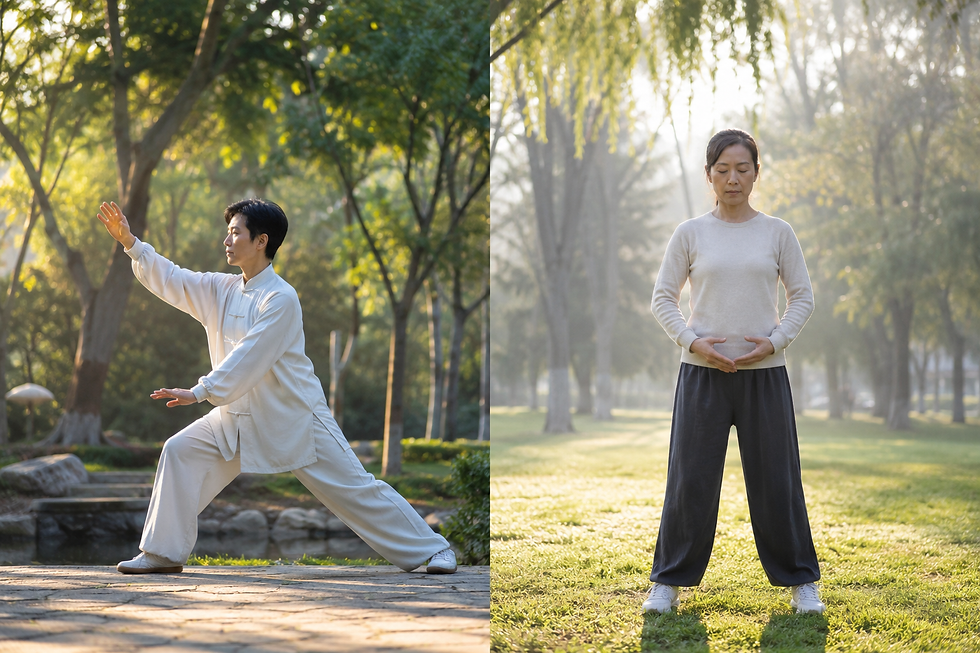
In a park early in the morning — anywhere from a Shanghai courtyard to a quiet corner of the Stanford campus — you may have seen a small group of people moving slowly together, their arms drifting in long arcs, their weight shifting from one leg to the other with the unhurried patience of something seasonal. Down the path, you might see another person standing almost completely still, hands resting at the lower belly, breathing in a way that seems somehow louder than ordinary breathing. The first is most likely a form of Tai Chi (太极). The second is most likely a form of Qigong (气功). And while the two arts come from the same ancient soil, they are not the same practice.

This piece is for anyone who has wondered which of the two they might want to try, or who has been told to "do some Tai Chi or qigong" by a doctor or friend and has no idea where to begin.
A shared root
Both Tai Chi and Qigong come out of the long, intertwined history of Daoist self-cultivation and Chinese medicine, with influences from Buddhist meditation along the way. Both rest on the same underlying intuition: that the body, the breath, and what classical Chinese thought calls qi (氣 — vital energy, life force, animating breath) are not three separate things but a single, moving whole. Both traditions assume that attention, posture, and breath, refined over time, can shift the body's tone in ways that ripple outward — into health, into mood, into one's relationship with the rest of the world.
So the disagreement is not at the root. It is in the shape the practice takes when it grows.
What Tai Chi is
Tai Chi — more formally Tai Chi Chuan, 太极拳, often rendered today as Taijiquan — is, in its bones, a martial art. The slow, flowing sequences that look so peaceful from a park bench are choreographed forms in which every movement, traced back, has a martial application: a redirection of force, a step, a yield, a strike. Most practitioners today never train it for combat, and that is fine — the form has long outgrown the battlefield — but the lineage matters, because it shapes how Tai Chi moves.
A Tai Chi form is a sequence. The movements connect, one rolling into the next, and the practitioner walks through them as a single, continuous piece of choreography. Hand follows foot, weight shifts smoothly between legs, the spine stays soft and vertical, and the breath rides the movement rather than commanding it. A practitioner learning the long Yang-style form, for example, will spend months simply remembering the order; the deeper work of relaxation (松 song), centering (中 zhong), and sinking (沉 chen) reveals itself slowly across years.
What this means, in felt experience, is that Tai Chi has a particular kind of mind in it. It is the mind of someone walking through a long poem they know by heart — not reciting it, but living inside it, allowing the rhythm and the meaning to keep them honest. That is the contemplative dimension of the art.
What Qigong is
Qigong is older as a term and broader as a category. The two characters qi (energy, breath) and gong (work, cultivation, skill) describe, between them, an enormous family of practices: standing postures, seated meditations, short repeated movements, breathwork, visualizations, sound practices. Some Qigong forms are explicitly medical, designed by physicians of classical Chinese medicine to balance specific organ systems. Some are spiritual, rooted in Daoist inner alchemy. Some are martial, used to condition the body's deep tissues. Some are devotional, used in Buddhist monasteries to settle the mind before sitting.
Compared to Tai Chi, a Qigong session often feels more like a practice than a piece. The movements may be short and repeated many times — the eight movements of Ba Duan Jin (八段锦, "Eight Pieces of Brocade"), for instance, are each performed several times in place before moving on. There is more room for the practitioner to slow down inside a single gesture and stay there. Some Qigong forms involve no movement at all, only standing still and feeling — zhan zhuang, "standing-like-a-tree," is a beloved example.
If Tai Chi is a long walk through a known landscape, Qigong is often closer to drawing a bucket from a well: simple, repeated, and deepening through return.
The difference you can feel
A useful way to put it: Tai Chi tends to ask the body to flow. Qigong tends to ask the body to open. Tai Chi practitioners often describe the experience as walking through water; Qigong practitioners often describe it as letting something quiet pool in the lower belly. Both arts cultivate the same underlying capacity — awareness inhabiting the body, breath inhabiting movement — but they approach it from different directions, and one will tend to suit a given practitioner more than the other, at least at first.
Neither is harder than the other. Neither is more advanced. Many of the great teachers of these arts practice both, and at the highest levels, the distinction begins to dissolve. But for someone deciding where to start, the texture of the practice is worth knowing.
A person who likes to learn something and live inside it over time may find Tai Chi a natural home. A person who wants a short daily ritual to settle the nervous system may find Qigong the easier door. Many people, in the end, do both — one feeding the other.
If you'd like to begin
At Dharma Alive Incubator, we offer both arts within a wider contemplative community. Master Yan Li, PhD, teaches Tai Chi Relaxation (太极解压) on Tuesday evenings, and an on-demand Tai Chi series is in production. The 8 Brocade video taught by Claudia Chunyun Wang, Ph.D. will be available for free for the DAI members.
Whichever you try first, the advice is the same: come as you are, in clothes you can move in, and let the practice instruct you. The forms have been refined across many centuries and many bodies. They know how to teach.

太极与气功,对许多在湾区的华人朋友来说,是一种带着乡愁的熟悉感——也许是清晨公园里那群慢慢推手的老人,也许是父母在家阳台上独自比划的几个简单动作。把这份熟悉带到异乡之后,许多人会想:我也想开始练,可是哪一种适合我?两者究竟有什么不同?
简单说:太极是一套连贯的拳路,从骨子里说是一门内家拳;它的形像走过一首长诗,前后呼应、绵延不断。气功则是一个更大的家族,包含站桩、八段锦、静坐、呼吸法等等——它的形像反复回到同一口井里打水,每一次都更深一点。两者同源于道家修身与中医的土壤,但在外在的形态上各自走向了不同的节奏。一个适合愿意慢慢走一段长路的人;一个适合愿意回到同一个简单动作里反复体会的人。
在 Dharma Alive Incubator,太极由 Yan Li 老师(李艳老师)周二晚上带领的"太极解压"课程教授;气功的八段锦在线课程由 Claudia Chunyun Wang 老师(王春云博士)正在制作中。无论你先尝试哪一门,建议都是一样的:穿一身能动的衣服,带着你今天的身体来——这两门艺术,几百年来已经教过无数双手和无数副肩膀,它们知道怎么教你。


Comments