
What Qigong Does in the Body: Fascia, the Immune System, and a Summer of Practice with Dr. Claudia Wang
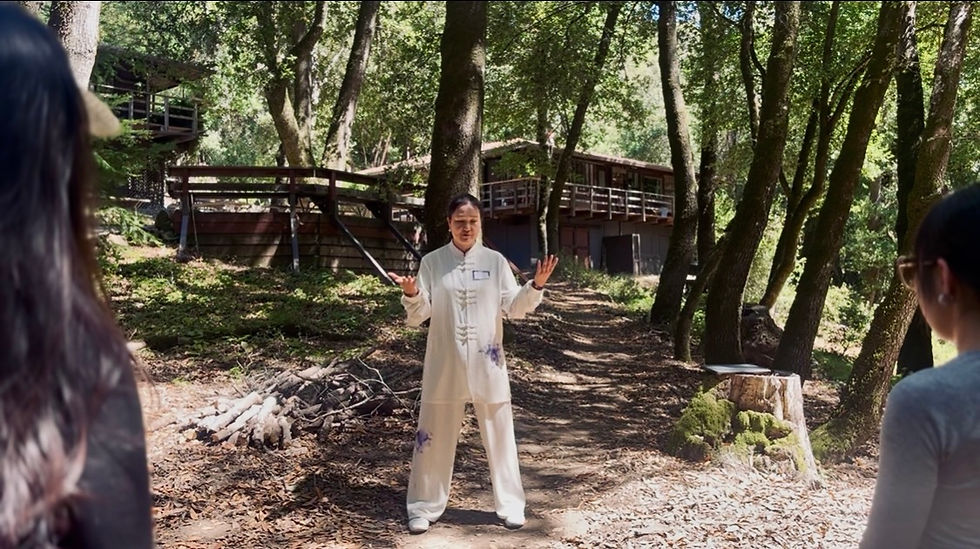
There is a particular quiet that settles over a group of people practicing Qigong outdoors — a quiet you can almost see. On a Saturday morning at Jikoji Zen Center, in the hills behind Palo Alto, a small circle of us stood among the trees while Dr. Claudia Wang led us slowly through the Eight Pieces of Brocade (八段锦, Ba Duan Jin). Arms rose to hold up the heavens; the breath lengthened; the mountain did what mountains do to a restless mind. By the third movement, something in the room of open air had changed. People who had arrived carrying a full week were, visibly, no longer carrying it in quite the same way.
This piece is about what Qigong is actually doing in the body when that happens — and about a season of practice with Dr. Claudia Wang that showed us, again and again, how quickly the practice works when it is met in person.


The body Qigong is working with
For a long time, the language of Qigong — qi (氣), meridians, cultivation — sat at some distance from the language of Western physiology, and a curious newcomer could be forgiven for wondering whether the two were describing the same body at all. In recent years that distance has begun to close, and one of the places it closes most interestingly is the fascia.
Fascia is the continuous web of connective tissue that wraps every muscle, organ, nerve, and bone — a single, body-wide fabric that holds us together and, we now understand, communicates across itself in ways science is only beginning to map. When you hold a Qigong posture and feel a slow line of sensation travel from the sole of the foot up through the leg and into the belly, you are, quite plausibly, feeling fascia: the tissue lengthening, hydrating, releasing a habit of holding it may have kept for years. The slow, sustained, gently loaded movements of Ba Duan Jin are almost a designed instruction for fascia — not the quick contraction of exercise, but the patient opening that connective tissue responds to.
There is a second thread worth naming, and it runs close to the first. A growing body of research has linked slow contemplative movement — Qigong among the most studied — to measurable shifts in immune function: changes in the markers of inflammation, in the activity of the cells that defend the body, in the stress physiology that, left unchecked, quietly wears the immune system down. The mechanism is not mysterious once the fascia is in view. A nervous system that has been coaxed out of its bracing, a fascial web that has been rehydrated and freed, a breath that has deepened and slowed — these are precisely the conditions under which the body's own repair and defense systems work best. Qigong does not add something foreign to the body. It removes the interference that was keeping the body from doing what it already knows how to do.
What in-person practice reveals
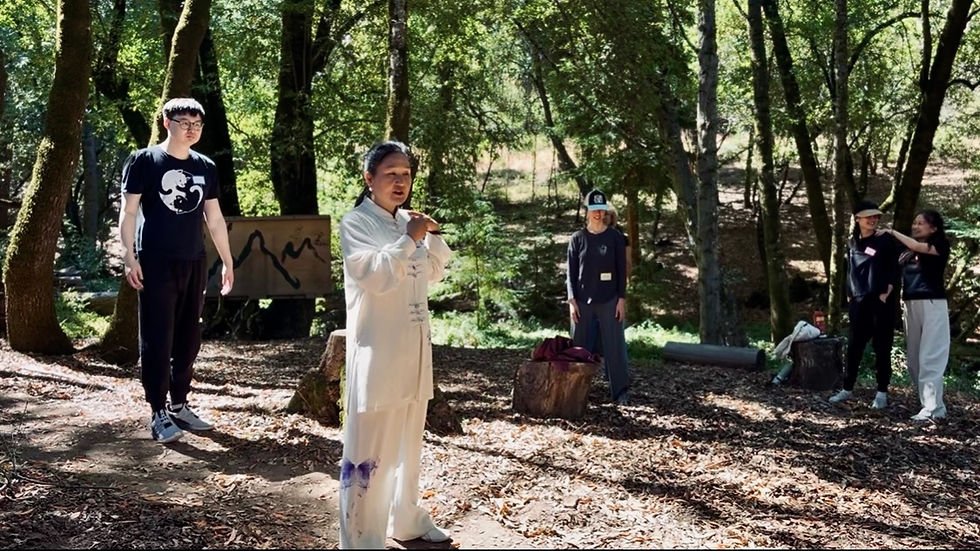
You can read all of the above and still not know it. That is the thing about this work: it is felt before it is understood, and it is felt most fully in a room — or a grove of redwoods — with a teacher present and other people practicing alongside you.
Hosting Dr. Claudia Wang at Jikoji was, simply, a treat. There is a particular joy in taking a practice out of the screen and into a real Bay Area Zen center, with the smell of the trees and the sound of the wind doing half the teaching for you. In-person work at a place like Jikoji is a blast in the truest sense — not because anything dramatic happens, but because the practice lands with a depth that solitary practice rarely reaches. The participants, without exception, reported an almost unbelievable degree of relaxation afterward, and — the detail that most interested us — a noticeably deeper meditation once the moving practice had done its work on the body. The Qigong had settled the nervous system so thoroughly that the sitting that followed opened onto a stillness people said they had not touched before.
This is one of the oldest observations in the contemplative traditions, confirmed once more in a grove of redwoods: the body settled by movement becomes a far more hospitable ground for the mind to settle in turn.

The practice that travels
What struck us most, though, happened not at the retreat but in the parks around the Bay. Dr. Wang has a habit of taking the practice outdoors into public space — a stretch of grass, a corner of a park — and simply beginning. What we did not fully expect was how the practice would meet the people who happened to be passing by.
Again and again, casual passers-by — people with no background in Chinese internal arts, no plan to try anything, often just curious for a moment — would join for a few minutes, follow a movement or two, and come away visibly moved by how much they felt in so short a time. A few minutes of Ba Duan Jin, done sincerely, is enough for a first-time body to register the change. That efficacy — the way the practice delivers something real almost immediately, to almost anyone — is not an accident of charisma. It is the practice itself, refined across a thousand years of bodies, doing exactly what it was shaped to do.

Where this is going
A season like this leaves you wanting to keep the door open. We are planning more online classes with Dr. Claudia Wang across the coming year — practice-along sessions and short teachings on each of the eight brocades — so that the work that felt so alive at Jikoji and in the parks can travel to wherever you happen to be practicing.
If you have been curious about Qigong — whether you first met it in a park in your childhood, or a doctor mentioned it once, and the word stayed with you — this is an easy door to walk through. Come as you are, in clothes you can move in, and let the practice instruct you. It knows what it is doing. It has known for a very long time.

— · —
By the DAI community. Featuring the Qigong teaching of Dr. Claudia Chunyun Wang.


Comments